

Why You Should Add Hanoi to Your RTW Trip
· Updated · BootsnAll
 Call it round the world, backpacking, a gap year or a sabbatical: Southeast Asia is where most long trips spend a chunk of their time, and the loop through Thailand, Cambodia, Laos and Vietnam is the best-worn path in the region for good reason. It is cheap, it is easy to move around, and the four countries are different enough from each other to keep the trip interesting.
Vietnam is the one people most often underrate, and Hanoi is the reason to fix that.
Why Vietnam earns its place on the loop
Vietnam runs 1,700 km north to south, which means it holds more variety than its neighbours: a proper cold winter in the northern mountains, an imperial city in the middle, the Mekong Delta in the south, and three thousand kilometres of coast joining them up.
It is also the easiest it has ever been to enter. The e-visa is open to every nationality now, up to 90 days, single or multiple entry, 25 or 50 dollars from evisa.gov.vn, and more than thirty nationalities get 30 or 45 days visa free. That is a change from the days when Vietnam was the country on the loop with the paperwork problem.
Budget on 40 to 50 dollars a day travelling in the ordinary backpacker style. Less if you are careful, and far less than most of what else you will do on a round the world trip.
What Hanoi gives you
Hanoi is more than a thousand years old and looks it, which is not true of Saigon. The Old Quarter is still organised by trade, with streets named for what was made and sold on them, and it is genuinely medieval in its layout even where the buildings are not.
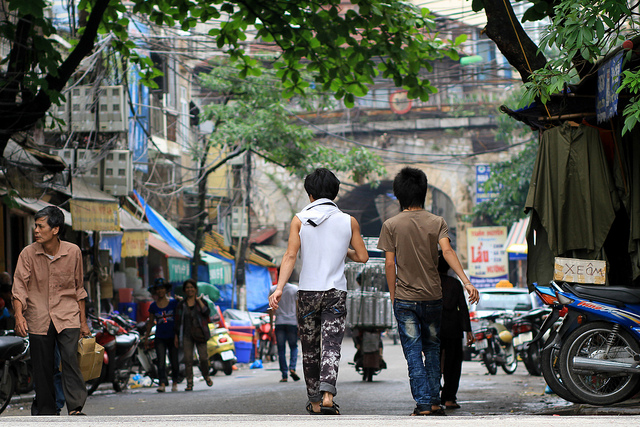
It is a hectic city and it defeats some people in the first forty-eight hours. The traffic is relentless, the pavements belong to parked motorbikes and food stalls rather than pedestrians, and the noise does not stop. Give it three days rather than one. It gets much better once you stop resisting it.
What to actually do: eat, mostly. Hanoi is one of the great street food cities. Pho for breakfast, bun cha at lunch, egg coffee in the afternoon, bia hoi on a plastic stool at the end of the day for less than a dollar a glass. The Temple of Literature is a thousand years old and worth an hour. Hoan Kiem lake is where the city takes its exercise at dawn.
Where it puts you
This is the practical argument. Hanoi is the gateway to the north, and the north is the best part of the country.
Halong Bay is two and a half hours away since the expressway opened. Sapa and the rice terraces are five and a half by van, or a night train if you prefer. Ninh Binh, which people call the inland Halong, is ninety minutes south. Luang Prabang is an hour's flight. Hong Kong is two.
From Hanoi you can also start the length of the country by rail and work south to Saigon over a week or two, stopping in Hue and Hoi An, which is one of the most satisfying overland runs anywhere on a round the world trip.
How it fits the ticket
Hanoi is well connected enough to be a stop on a multi-stop or round the world fare rather than a detour bought separately, and the onward hops within the region are cheap enough that adding Vietnam to an existing Southeast Asia leg costs very little.
If you are building a route and wondering whether to fly into Bangkok and out of Singapore, consider entering at Hanoi and working south instead. You end up covering more ground and repeating less of it.
When to come
Hanoi has four seasons, which visitors expecting tropical heat find surprising. Winter, December to February, is cool and grey and can drop to ten degrees. Summer is hot and very humid with heavy rain. Autumn, roughly September to November, is the best time to be in the city.
Avoid Tet, the lunar new year, unless you want to see it specifically. The whole country travels at once, transport sells out, and much of Hanoi closes for several days.