
Getting from Copenhagen to Stockholm
· Updated · BootsnAll
 Copenhagen and Stockholm are the two capitals most people pair on a first trip to Scandinavia, and they are less alike than the pairing suggests. Copenhagen is low, flat and built for bicycles. Stockholm is spread over fourteen islands and built for boats. Between them lies most of the width of southern Sweden.
Trains from Copenhagen to Stockholm
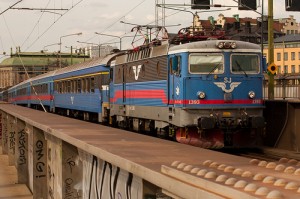
The train takes a little over five hours and is the way to do this trip. SJ runs it, several times a day, and the route crosses the Öresund Bridge into Malmö and then runs north through Lund and the Swedish interior.
Two things worth knowing before you book.
First, the passport. Sweden has run identity checks on the Öresund crossing since 2016. EU citizens can use a national ID card and everybody else needs a passport to hand. This is not a formality you can skip.
Second, there is a new operator on the corridor. From 4 May 2026 Snälltåget began running direct trains between Hamburg and Stockholm via Copenhagen and Malmö. If your trip involves Germany as well, that is a single train for a journey that used to need two or three, and it is worth checking against SJ on price.
Fares go on sale months ahead and climb steeply as departure approaches. On a route this long the difference between booking early and buying on the day can be more than the cost of a night's accommodation.
Flying
An hour and ten in the air, and this is the one Scandinavian city pair where flying is a defensible choice rather than a lazy one. Five hours is a long time to give a train.
Do the whole-journey arithmetic before you decide. Arlanda is 40 km outside Stockholm, though the Arlanda Express gets you in quickly. Copenhagen's airport, by contrast, is a short metro ride from the middle of town and sits directly on the railway, which quietly tips the balance back towards the train.
If you do fly, look at what you are flying into. Some cheap fares land at Skavsta, which is around 100 km from Stockholm and is an airport called Stockholm in the way that Weeze is an airport called Düsseldorf.
Buses
Coaches take eight to nine hours and cost less than either. Overnight departures save you a hotel night. FlixBus is the main operator.
That is a real saving on a long trip and a miserable way to see a country. Your call.
Driving
About 650 km and six and a half hours, plus the Öresund Bridge toll each way. Unless you are stopping along the way, this is the worst of the options: you arrive tired in a city where parking is expensive and a car is a liability.
If you are stopping, the case improves. The Swedish south coast and the university town of Lund are both close to the bridge, and Kalmar and the island of Öland are a reasonable detour if you have a day to spare.
Overnight, and by pass
There is a case for doing this one at night. Snälltåget's Hamburg service runs through Copenhagen and Malmö with couchettes and sleeper cabins, so you can go to bed in one country and wake up in another and save a hotel night doing it. Sleeper capacity on Scandinavian trains is limited and it sells out early in summer.
Interrail and Eurail passes cover the route. The Öresundståg legs need no reservation; the SJ legs do, and it is booked separately from the pass. Do not leave that to the day of travel in July.
Where the trains actually put you
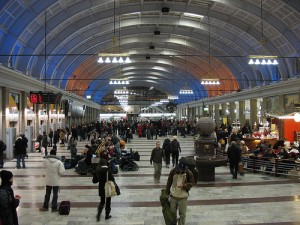
Both ends are central, which is the whole argument for the train. København H is a ten minute walk from Tivoli and the start of the pedestrian streets. Stockholm Centralstation is on the edge of Norrmalm with the metro underneath it and Gamla Stan two stops away.
Compare that with Arlanda, 40 km out, or Skavsta, 100 km out, and the five hours on the train starts to look shorter than it reads.
Luggage and food
No weight limits, no charges, no dropping anything at a bag desk. Bring whatever you like.
There is a bistro car on the long-distance trains, and it is priced the way everything in Scandinavia is priced. Buying lunch at the station before you board saves a surprising amount over five hours.