Getting from Guatemala City to Antigua
· Updated · BootsnAll
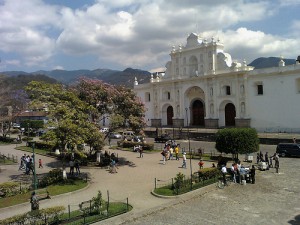 Guatemala City is where you land and Antigua is where you actually want to be. The old colonial capital sits 45 km west, ringed by three volcanoes, and is a UNESCO World Heritage Site of cobbled streets, pastel walls and ruined churches left standing after the earthquake of 1773 moved the capital away.
Almost every visitor makes this journey within hours of arriving. Here is how.
Shuttle, which is what to take
Tourist shuttles run between La Aurora airport and Antigua all day, take about an hour to an hour and a half depending on traffic, and cost a modest amount per person. They are minibuses, they are booked in advance or at a desk in the arrivals hall, and they drop you at your hotel.
This is the right choice for a first arrival. You are jet-lagged, you have luggage, and it is door to door.
Book ahead if you are arriving late; the service thins out in the evening.
Private taxi or transfer
Costs several times the shuttle and leaves when you do rather than when the minibus fills. For a group it works out reasonably per head.
Arrange it through your accommodation or at an official desk inside the terminal, and agree the price before you get in.
Chicken buses
The cheap way, and an experience in itself. Old American school buses, repainted in extravagant colours, packed well beyond their design capacity, driven with enthusiasm.
The complication is that there is no direct one from the airport. You take a local bus or taxi into Guatemala City to a terminal, then a bus to Antigua. For a few dollars saved, with bags, on arrival, it is not worth it.
Do ride one later in your trip, though. Between Antigua and the villages around Lake Atitlán it is the normal way to travel and it costs almost nothing.
A word about Guatemala City
Most travellers pass straight through and that is a defensible choice. The city has a poor safety reputation, some of it earned, and it is organised into numbered zones that vary enormously.
If you do stay, Zona 10 and Zona 14 are the modern districts where the hotels are, and Zona 1 has the historic centre and the Palacio Nacional. Take taxis after dark rather than walking between zones.
The airport itself is in Zona 13 and is close to those hotel districts, which is why a night there works if you have an early flight.
Onward from Antigua
Antigua is the hub for everything else. Shuttles run from there to Lake Atitlán, about three hours; to Chichicastenango for the Thursday and Sunday markets; and to Semuc Champey and Tikal, both of which are long journeys better done by internal flight or overnight bus.
Volcán de Fuego, visible from Antigua, is one of the most active volcanoes in Central America and erupts regularly. The standard overnight hike is up neighbouring Acatenango to watch it, which is spectacular, cold and harder than most people expect at 3,976 metres.